
14 th FINT CONFERENCE
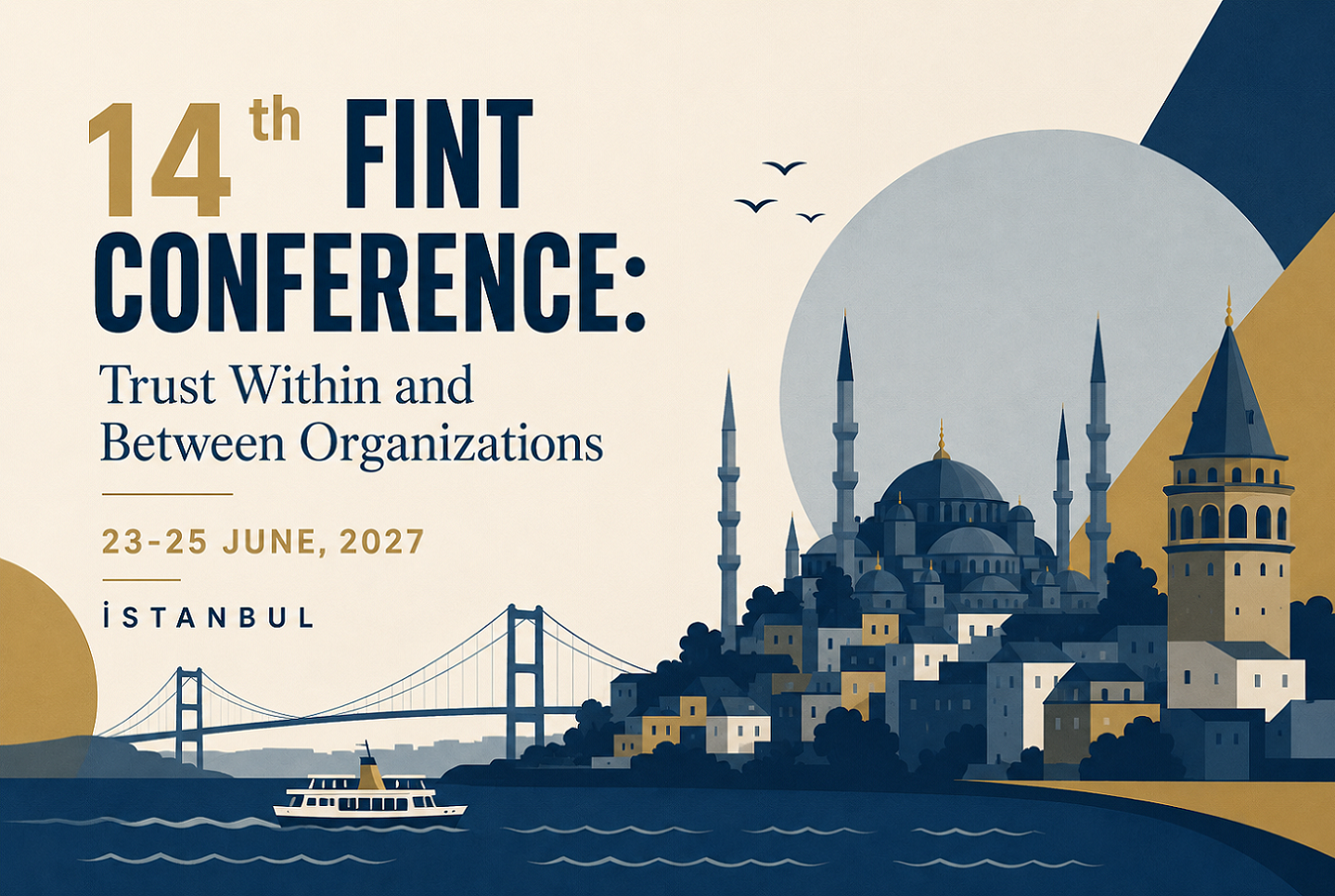
14th FINT Conference
Trust Across Borders: Bridging Divides in a Fragmented World
İstanbul, Türkiye June 23–25, 2027
In an increasingly interconnected yet deeply fragmented world, trust is being tested across multiple boundaries—national borders, organizational boundaries, technological interfaces, cultural divides, and ideological fault lines. Rising geopolitical tensions, migration flows, economic uncertainty, climate crises, political polarization, and the rapid expansion of artificial intelligence are reshaping how individuals, organizations, and societies cooperate under conditions of uncertainty.
At the same time, organizations are becoming more globally dispersed, culturally diverse, and technologically mediated. Employees increasingly collaborate across countries, time zones, identities, and digital platforms. Institutions are navigating declining public confidence, while individuals are asked to place trust in unfamiliar others, complex systems, and emerging technologies. These developments raise fundamental questions about how trust is built, maintained, violated, repaired, and transformed across boundaries.
The theme of the 14th FINT Conference—Trust Across Borders: Bridging Divides in a Fragmented World—invites scholars to examine how trust operates when individuals, groups, organizations, and societies must bridge differences in culture, identity, geography, institutions, and technology. We encourage submissions that explore both traditional and emerging forms of trust, distrust, vulnerability, cooperation, and relationship repair in an era marked by mobility, uncertainty, and rapid change.
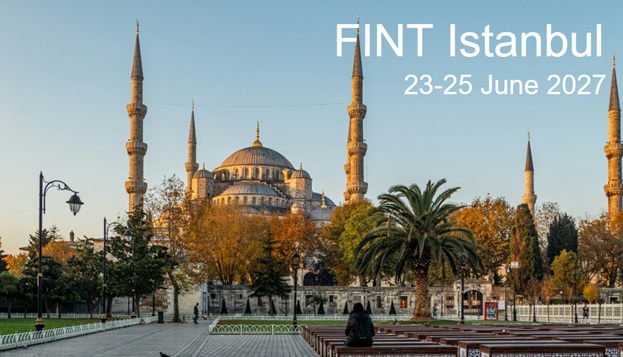
Held in İstanbul, Türkiye, the conference location itself reflects the spirit of this year’s theme. For centuries, İstanbul has served as a bridge between continents, cultures, religions, and commercial networks—linking Europe and Asia while embodying both continuity and transformation. As a city shaped by exchange, diversity, and movement, İstanbul offers an ideal setting to reflect on how trust develops across boundaries and what enables collaboration amid difference.
The conference welcomes research addressing trust at multiple levels of analysis, including interpersonal, team, organizational, institutional, and societal contexts. Relevant topics may include, but are not limited to:
- Trust across cultures and national boundaries
- Workplace relationships in increasingly diverse organizations
- Trust in global and virtual teams
- Interorganizational trust across national and institutional boundaries
- Migration, mobility, and social integration
- Trust in artificial intelligence and emerging technologies
- Institutional trust and distrust
- Betrayal, repair, and reconciliation across divides
- Political polarization and social cohesion
- Cross-sector trust in sustainability and global governance
- Trust in crisis response and humanitarian collaboration
Considering how the topic of trust crosses disciplinary boundaries, the FINT Conference encourages proposals that examine trust through different theoretical lenses and empirical approaches. We welcome qualitative, quantitative, experimental, mixed-method, and interdisciplinary work from scholars across management, psychology, sociology, political science, economics, communication, technology studies, and related fields.
The conference particularly encourages submissions from scholars at different career stages and from diverse global contexts, reflecting the international and interdisciplinary spirit of the FINT community. We look forward to welcoming you to İstanbul in 2027 to advance new insights on trust in an increasingly interconnected yet divided world.
Paper Formats
We invite you to submit a paper in one of four categories:
First Cut Papers
Papers under development can be submitted as a “First Cut Paper”. These papers will be featured in conference sessions designed to provide the maximum amount of feedback to authors. Papers in this category should be submitted as an extended abstract up to a maximum of 1500 words, including title and abstract. You will not be required to submit a full-length paper in advance of the conference.
Conference Papers
Well-developed manuscripts nearing journal submission or publication can be submitted as a “Conference Paper.” Papers in this category can be up to a maximum of 3000 words including title and abstract. You will not be required to submit a full-length paper in advance of the conference.
Alternate Format Submissions (Symposia, Panels, etc.)
We would be excited to welcome submissions for alternative sessions, including symposia, interactive panel discussions, workshops, and other innovative formats (feel free to be creative!). Unlike the paper submissions, these submissions are not blind review and should include a title page with the names, affiliations, and roles of people who will be leading, presenting, or speaking in the session. Alternate format submissions should be no longer than 3000 words (including title page, abstract, figures/tables, references etc.). Successful submissions will typically be assigned a 1.5-hour session within the conference program. Please note that we have limited space for alternate sessions.
Junior Faculty/Doctoral Student Colloquium
PhD students and early career academics in the first years of their careers are warmly invited to attend and submit a paper to the FINT Doctoral & Early Career Colloquium 2027. It will be held on 23 June 2027, the day before the main program of the FINT Conference.
The Colloquium will include a 2-hour roundtable discussion where participants will have the opportunity to present and receive feedback on a research paper or proposal from established trust researchers in the FINT community. It will also include interactive panel discussions and exercises designed to provide guidance and reflection on academic life and the publication process, as well as build connections. The colloquium offers a unique opportunity to network with other early-career scholars and trust scholars, and to reflect on one's academic career in a supportive and developmental environment.
If you would like to participate, please complete the application form and submit together with either a research overview or paper. The deadline for submission is 14 December 2026 via the main submission portal.
- Complete and submit the attached application form and reflection exercise.
Download the form
Submit one of the following options:
Please indicate your name (and co-authors), affiliation and e-mail address at the beginning.• A 5-page research overview: In the overview, ensure you clearly explain the relevance of the chosen topic, research question, theoretical background and research contribution. Empirical articles should provide an overview of the methodology, analysis and key findings.
• A research paper: The paper must not exceed 40 pages (inclusive of all references, figures and tables) in the following format: 12 pt, Times New Roman, double spacing, numbered pages, APA-style citations. The paper will be shared with an experienced trust expert who will provide feedback at the Colloquium.
The Doctoral and ECR Colloquium is organized by Nicole Gillespie (U. of Melbourne) and Guido Möllering (University of Witten/Herdecke).
If you have any questions about the Doctoral and ECR Colloquium, please contact Nicole Gillespie (U. of Melbourne) at N.Gillespie@mbs.edu or Guido Möllering at Guido.Moellering@uni-wh.de
Submission Guidelines
In all categories, papers should be submitted in MSWord or PDF with double spacing, 12pt Times New Roman font, numbered pages, and APA-style citations. Your paper should clearly explain the relevance of the chosen topic, the research question, theoretical background, and the contribution of the research. Empirical papers should provide an overview of their methodology, analysis, and main findings.
To facilitate double-blind review please ensure your submission document excludes any author names or identifying information. Details of authorship can instead be provided through the paper submission system.
Submission Deadline: 6 November 2026
Submission Link: https://fint2027.exordo.com
Queries can be directed to fint2027.sbs@sabanciuniv.edu
Keynote Speaker: Michele Gelfand

We are delighted to announce Michele Gelfand, Professor of Cross-Cultural Management and Psychology by Courtesy at Stanford University, as the keynote speaker at the upcoming FINT Conference.
Gelfand uses field, experimental, computational and neuroscience methods to understand the evolution of culture and its multilevel consequences. Her work has been published in leading journals, including Science, the Proceedings of the National Academy of Sciences, Psychological Science, and Nature Human Behavior. She is the founding co-editor of the Advances in Culture and Psychology series (Oxford University Press). Her book is Rule Makers, Rule Breakers: How Tight and Loose Cultures Wire the World (Scribner, 2018).
Her many honors include the 2020 Rubin Theory-to-Practice Award from the International Association of Conflict Management, the 2021 Contributions to Society Award from the Organizational Behavior Division of the Academy of Management, the 2022 Distinguished Scientific Contributions Award from SIOP, the 2027 Lifetime Mentorship Award from APS, and the Annaliese Research Award from the Humboldt Foundation. Gelfand is a member of the American Academy of Arts and Sciences, the National Academy of Sciences, the British Academy, and the Council on Foreign Relations. She is currently working on a grant on culture and trust for the Templeton Foundation.
Sabancı Business School
Sabancı University Orta Mah. Üniversite Cad. No:27 Orhanlı-Tuzla, 34956 Istanbul, Turkey